Short answer
An infant cannot complete standard behavioural pure-tone audiometry in the same way as an adult. A baby cannot reliably press a button or raise a hand every time a sound is heard.
For that reason, hearing sensitivity in early infancy is estimated with objective methods. Frequency-specific ABR is often central, with ASSR added when clinically useful. OAE contributes information about outer-hair-cell/cochlear function, tympanometry evaluates the middle ear, and bone-conduction measures can help distinguish conductive from sensorineural components.
The key principle is not to search for “one perfect test,” but to build a consistent picture from several measures and later cross-check it with behavioural audiometry when the child can participate reliably.
Why can’t an infant simply have a regular audiogram?
Standard pure-tone audiometry requires a conscious, repeatable response. An adult presses a button; an older child may perform a conditioned play task.
An infant’s startle, head turn or facial change can be useful observational information, but those responses are too dependent on state, attention and stimulus level to create a precise frequency-specific behavioural audiogram on their own.
That is why physiologic and electrophysiologic tests play a central role in the first months of life.
What does “objective threshold estimation” mean?
Objective assessment means the clinician records a physiologic response to sound without requiring the child to consciously report hearing it.
However, “objective” does not mean “perfectly exact and interpretation-free.”
Electrophysiologic estimates are influenced by:
- stimulus type;
- frequency;
- equipment;
- recording quality;
- movement and muscle artefact;
- middle-ear status;
- clinical correction procedures.
The final interpretation therefore depends on the complete test battery.
Frequency-specific ABR: a core early threshold tool
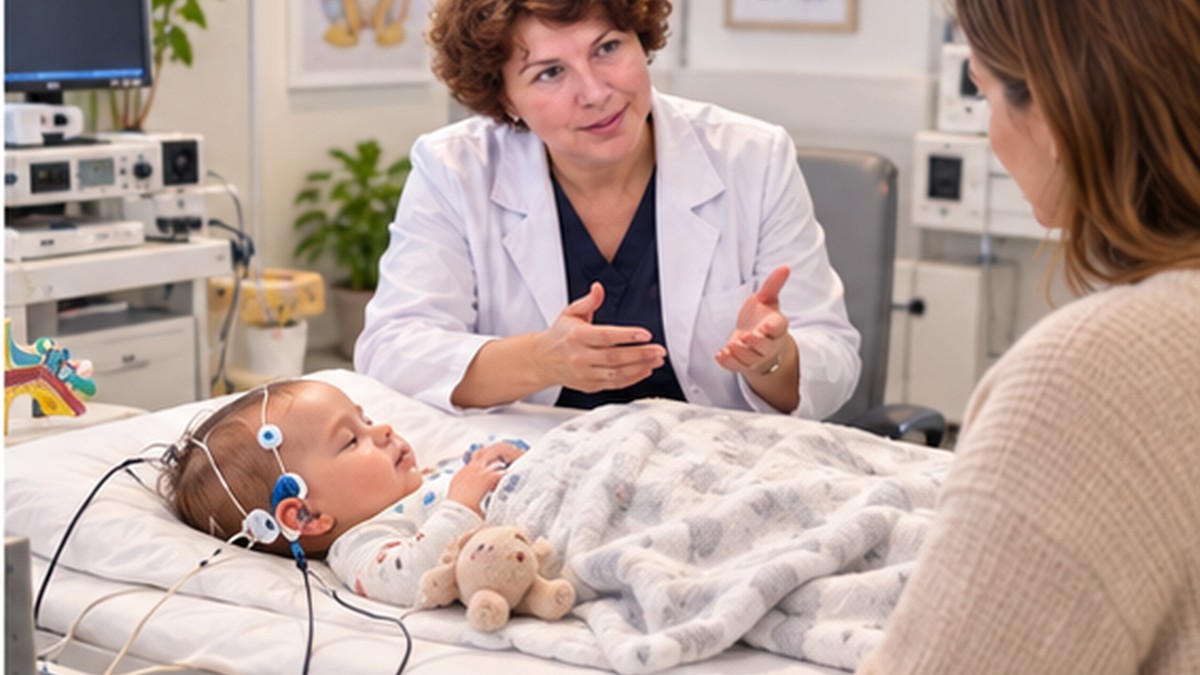
During ABR, sound is delivered to the ear while surface electrodes record the auditory pathway’s electrical response.
For threshold estimation, frequency-specific stimuli are used. The level is reduced until the lowest repeatable response is identified.
ASHA describes ABR as a key threshold-estimation procedure for children who are too young to complete reliable behavioural pure-tone testing.
The resulting electrophysiologic estimate should not be copied directly into an adult-style behavioural audiogram without method-specific interpretation. ABR estimates and later behavioural thresholds can differ.
What does ASSR add?
ASSR can also provide objective frequency-specific information.
Kazakhstan’s current audiological-care rules specifically include steady-state auditory evoked potentials to frequency-modulated tones as a method for objectifying hearing-sensitivity thresholds in children.
ASSR may be useful when:
- a broader frequency picture is needed;
- severe or profound hearing loss is being evaluated;
- the clinician wants additional cross-check information alongside other electrophysiologic estimates.
ASSR does not automatically replace ABR.
Why is OAE still needed?
OAE assesses outer-hair-cell function in the cochlea. That is a different clinical question from electrophysiologic threshold estimation.
OAE is valuable because it helps cross-check cochlear function against ABR/ASSR findings.
For example, auditory neuropathy can present with preserved OAE and markedly abnormal ABR. That discrepancy would be clinically important and could be missed if only one test were considered.
What does tympanometry contribute?
Sound must pass through the outer and middle ear before reaching the cochlea.
If the middle ear contains fluid or has another conductive problem, air-conduction electrophysiologic estimates may appear elevated and OAE may be absent.
Tympanometry helps identify this middle-ear contribution.
Kazakhstan’s current infant re-screening pathway includes OAE, short-latency auditory evoked potentials and tympanometry.
Air conduction and bone conduction
If air-conduction thresholds appear elevated, the clinician may need to determine the type of hearing loss.
Air conduction
Sound travels through the normal outer- and middle-ear pathway to the cochlea.
Bone conduction
A bone oscillator transmits vibration through the skull, partly bypassing the outer and middle ear.
Comparing air- and bone-conduction responses can help identify a conductive component versus a sensorineural component. Interpretation in infants still depends on age, oscillator placement and the rest of the test battery.
Can all thresholds always be obtained in one visit?
Sometimes a very complete data set can be obtained in one session, but that cannot be guaranteed.
A baby may wake, movement artefact may reduce recording quality, middle-ear findings may change the plan, or additional bone-conduction/frequency testing may be needed after an unexpected result.
Reliable information is more important than a promise to “finish everything in 30 minutes.”
What is the clinician trying to establish overall?
A complete objective assessment may ask several questions:
- Is there a repeatable electrophysiologic response to sound?
- What are the frequency-specific estimates of hearing sensitivity?
- Is there a middle-ear component?
- Is outer-hair-cell function present?
- Is there a mismatch between OAE and neural responses?
- Is bone-conduction testing needed?
- Would ASSR add useful frequency-specific information?
- When should behavioural cross-check be performed later?
The result is therefore a clinical hearing profile, not a single number.
Why is behavioural testing still needed later?
Objective testing is essential in infancy, but once the child can respond reliably, behavioural thresholds should be obtained and compared with the early electrophysiologic estimates.
The American Academy of Audiology recommends this cross-check principle: behavioural, physiologic and electrophysiologic findings should confirm one another, and discrepancies should be investigated.
Frequently asked questions
Can the degree of hearing loss be estimated without an infant’s conscious response?
Yes. Electrophysiologic methods can provide early estimates of hearing sensitivity and the likely degree of hearing loss, but the final interpretation should reflect the full test battery.
Which test is better: ABR or ASSR?
That is the wrong comparison. They provide overlapping but different information and are selected according to the diagnostic question.
Does OAE show hearing thresholds?
No. OAE assesses outer-hair-cell/cochlear function and is not a full threshold audiogram.
If my baby responds well to sounds at home, are objective tests unnecessary?
Home observations are useful, but they do not provide frequency-specific threshold estimates and do not replace clinical testing when there is a medical indication.
When can behavioural audiometry begin?
That depends on developmental age and the child’s ability to give repeatable responses. The audiologist selects an age-appropriate method such as visual reinforcement or conditioned play audiometry when feasible.
Objective infant hearing assessment in Almaty
Ekaterina Vladimirovna Kravchenko provides paediatric objective hearing assessment and selects the test battery according to age, previous results and the clinical question.
Related pages: