How early can hearing be assessed?
Hearing can be assessed from the first days of life. Infants are tested with objective methods such as otoacoustic emissions (OAE), auditory brainstem response (ABR), and when appropriate auditory steady-state response (ASSR). These methods do not require the baby to press a button or follow spoken instructions.
Newborns and infants
Behaviour alone is not enough to define hearing thresholds in a young infant. OAE assesses cochlear outer-hair-cell responses. ABR records how the auditory pathway responds to sound. ASSR can help estimate frequency-specific thresholds. Tympanometry provides information about middle-ear function.
Preschool children
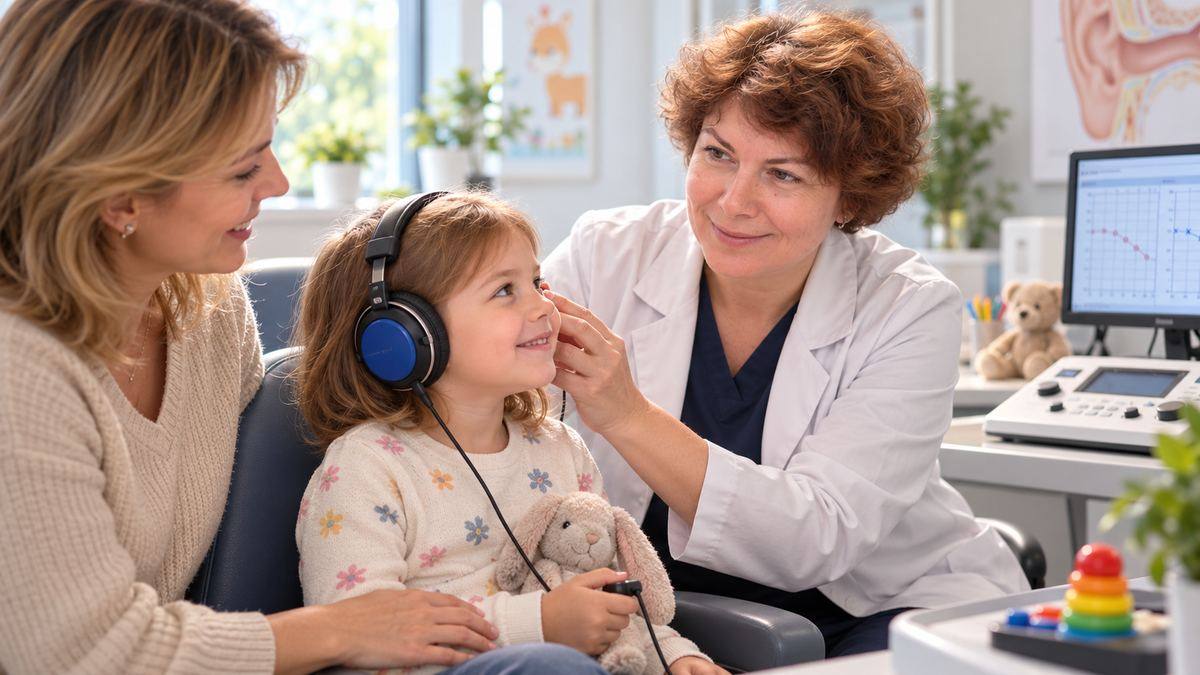
When a child can understand the task, conditioned or play audiometry may be used. If responses are inconsistent, or developmental factors make behavioural testing unreliable, objective tests can complement the assessment.
School-age children
Most school-age children can complete conventional pure-tone audiometry. Speech understanding and middle-ear function may also be assessed depending on the complaint.
What signs justify a hearing check?
Consider assessment when a child often does not respond to their name, needs unusually high television volume, has concerns about speech development, recurrent middle-ear problems, or listening difficulty noticed by parents or teachers. None of these signs proves hearing loss, but they are reasonable reasons to check.
Key point
A good pediatric hearing assessment does more than answer yes or no. It aims to understand hearing by frequency, middle-ear status and the reliability of the auditory response using methods suited to the child's age and abilities.