Short answer
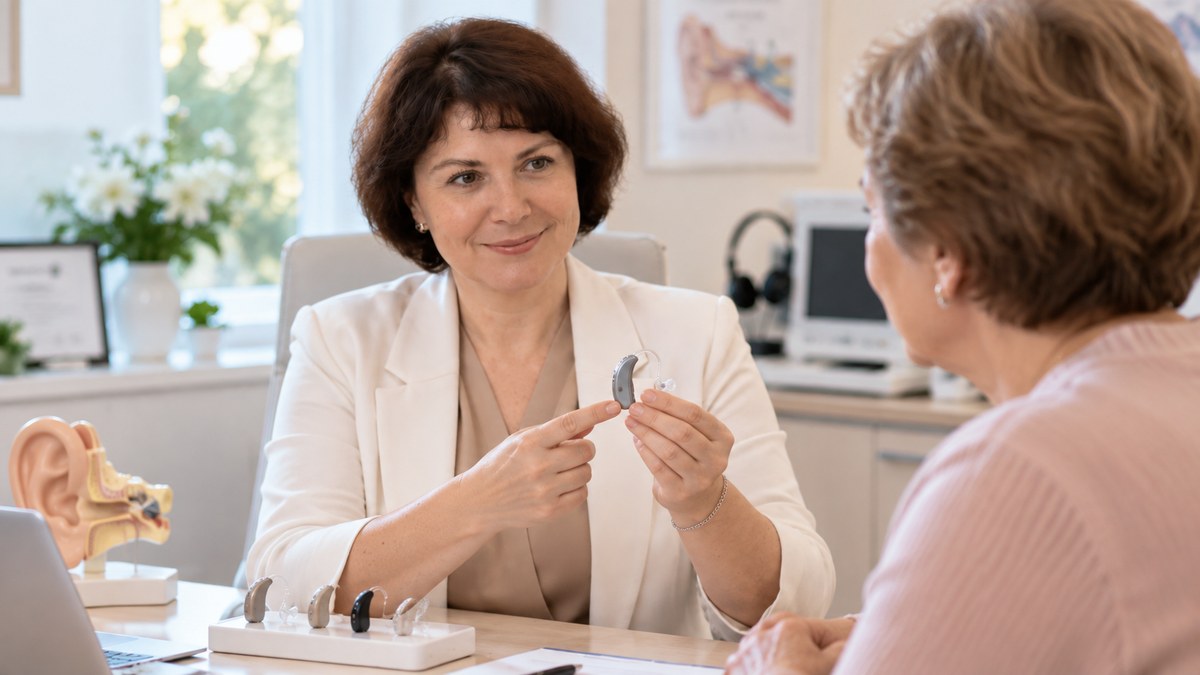
The first hearing-aid fitting is the beginning, not necessarily the final setting. In the clinic, the device can be programmed from your hearing test and checked for basic comfort, but real life shows what happens in restaurants, cars, meetings, phone calls and at home.
A follow-up visit checks three practical things: whether the device fits comfortably, whether it helps in situations that matter to you, and whether the programming needs fine-tuning.
Why one fitting may not be enough
After using hearing aids in daily life, people may notice:
- household sounds are too sharp;
- their own voice sounds boomy;
- speech is audible but not clear;
- feedback/whistling occurs;
- the fit is uncomfortable;
- noisy places remain very difficult;
- phone or Bluetooth use is inconsistent.
These details are difficult to predict completely during the first appointment.
What is checked at follow-up?
Physical fit
The hearing aid should not hurt, rub, fall out or whistle constantly. Fit and acoustic seal are reviewed.
Sound quality
The goal is not simply “louder.” Speech, household sounds and your own voice should be comfortable and useful.
Real-life benefit
The audiologist asks whether communication is easier at home, at work, while watching television, in the car and in other situations important to you.
Programming
If needed, gain, microphone behaviour, noise-management settings and listening programs can be adjusted within the capabilities of the device.
What does verification mean?
Verification means checking whether the hearing aid is actually providing the intended amplification.
One objective method is real-ear measurement. A very thin probe tube is placed in the ear canal near the hearing aid so the clinician can measure the sound that is actually reaching the ear.
In simple terms: instead of relying only on settings shown on a computer screen, the professional checks what the device is really doing in your ear.
Real-ear measurement is an evidence-based verification method, but it is only one part of a complete follow-up. Your comfort, communication goals and real-life experience still matter.
What should I bring to a follow-up visit?
A short list of real situations is very useful:
- “home is much better”;
- “TV still needs to be loud”;
- “restaurants are difficult”;
- “my own voice booms”;
- “the right aid whistles”;
- “phone is good, car is difficult”.
Specific examples make fine-tuning much more useful than simply saying “the sound is bad.”
When should hearing be tested again?
A planned hearing reassessment may be appropriate if:
- the hearing aids used to help more, but the benefit has gradually declined;
- hearing has gradually changed without a new marked difference between the two ears;
- new persistent tinnitus or a blocked-ear sensation develops without an acute hearing change;
- you keep increasing volume without better clarity;
- a long time has passed since the last diagnostic test;
- your complaints no longer match the current settings.
If one ear has become noticeably worse than the other, even gradually, this deserves medical assessment rather than routine device adjustment alone.
If hearing drops suddenly or changes markedly in one ear, or you develop new ear pain, discharge, significant dizziness or other acute ear symptoms, seek medical assessment rather than treating this as a routine hearing-aid follow-up.
FAQ
If I need fine-tuning, was the first fitting wrong?
No. Real-world listening gives new information. Fine-tuning is a normal part of hearing-aid care.
Can I adjust everything in the phone app?
User controls can be useful, but persistent problems with fit, feedback, speech clarity or sound quality deserve professional review.
What are real-ear measurements?
They are objective measurements of hearing-aid output in your own ear canal.
Do I need a new device if noisy places are still difficult?
Not automatically. First review the hearing, fit, programming and the exact listening situation.
Hearing-aid follow-up in Almaty
Ekaterina Vladimirovna Kravchenko provides hearing-aid fitting, programming and follow-up in Almaty. A follow-up visit can review physical fit, real-life listening problems and device settings.
Related pages:
Sources and clinical guidance
- ASHA — Hearing Aids for Adults: fitting, verification and real-ear/probe-microphone measures
- American Academy of Audiology — Hearing Aids: real-ear measurement and follow-up fine-tuning
This article is for information and does not replace an in-person medical assessment or individualized hearing-aid fitting.